How to Dub a Video Online
From upload to finished master — the real order of operations and what to watch at each step.
The online dubbing chain is fixed: upload → transcribe → proofread → translate → pick a voice → generate → export. To make it concrete, I ran a 12-minute product tutorial through it — a Chinese master turned into five outputs (Chinese, English, Japanese, Spanish, Portuguese) — and went from upload to finished masters in 38 minutes. Less than 10 of those were the machine 'thinking'; the rest was review.
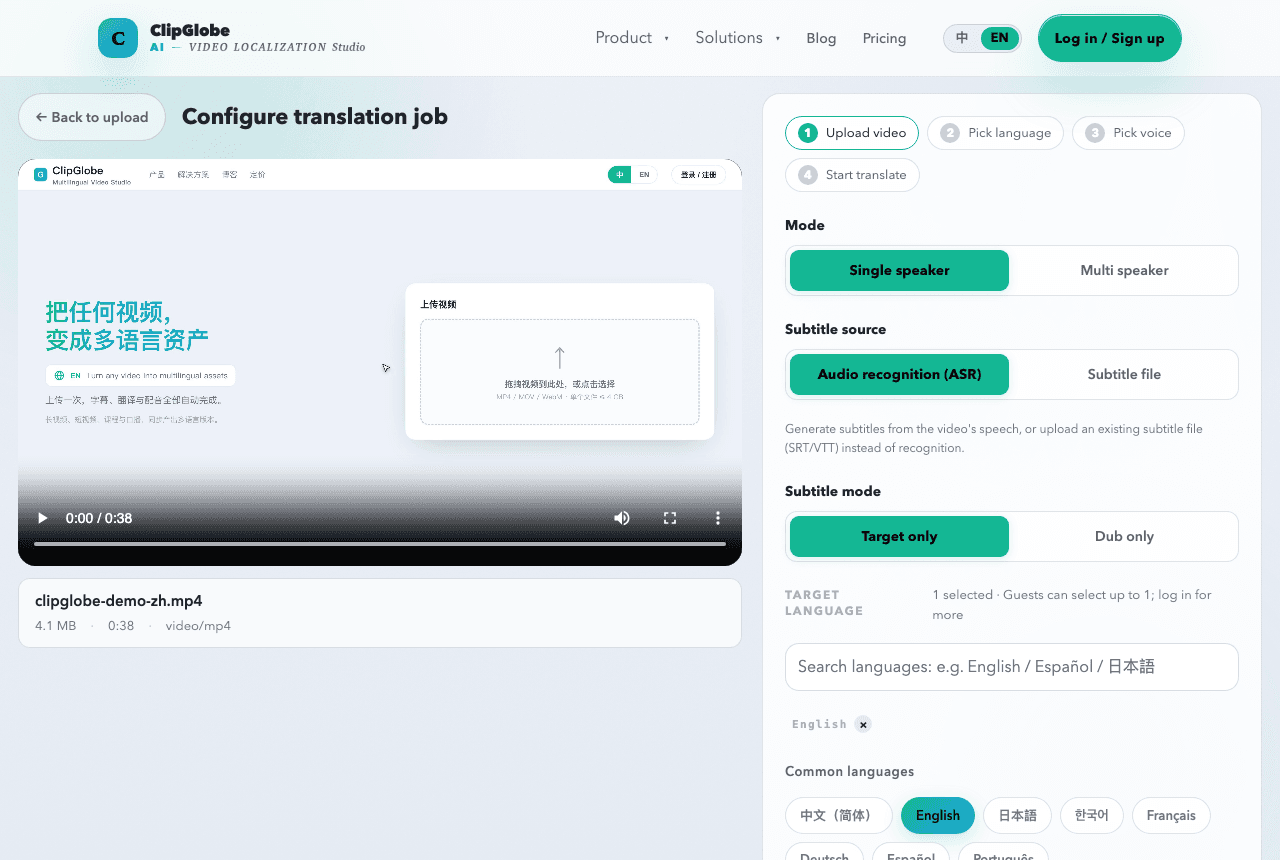
Step 1: Upload and transcribe (~3 min)
- Drag in an mp4/mov — no software. Our 12-minute clip returned a transcript in about 90 seconds.
- AI produces a timestamped script; before moving on, scan it for misread product names.
Step 2: Proofread — the step everyone skips, that decides the floor
This step sets your quality floor. One typo in the transcript rides through translation and dubbing into the final cut, and you redo the whole thing.
- Check proper nouns, numbers, acronyms first — '3.5K' and '3,500' sound nothing alike.
- Re-listen to heavy-accent or overlapping-speech segments; fix the script manually if needed.
Step 3: Translate + glossary (where 'multilingual' actually lives)
What makes five languages feel like one company isn't the voice — it's the glossary. Pin your brand, product and unit names and the same term gets exactly one translation everywhere.
- Lock 'ClipGlobe / timeline / subtitle track' so they don't drift across languages.
- Split long sentences; the dub pauses more naturally and subtitles won't overflow.
Step 4: Pick and audition a voice
- Audition the first 30 seconds — listen for pause, stress, intonation; neutral voices are fine for tutorials.
- Need the original speaker's voice? Use voice cloning — we cloned the host's Chinese voice for the English cut and it stayed coherent.
Step 5: Generate, preview, export
- After generating, watch the first 30 seconds — sync and subtitle issues almost always surface there.
- Export at original quality and platform ratio (e.g. 9:16) to avoid re-compression; export SRT/VTT too if you want search visibility.
Three pitfalls we see most
- Skipping proofread — the dub reads the typo aloud, full redo.
- No glossary — your brand name gets five spellings across five languages.
- No preview before export — subtitle misalignment found only in the final cut.