How Companies Use a Dubbing Platform
Training, product demos, ads and support — a repeatable multilingual workflow.
Treating one source video as an asset and using a platform to ship multilingual versions saves the most not on 'translation fees' but on 'each new language costing only minutes.' A common example: an 8-minute product demo going to five markets (EN, JA, ES, DE, PT). The traditional route means five voice agencies or internal re-records — 2–3 weeks of scheduling, hundreds to thousands per language. In ClipGlobe, upload + glossary + a cloned brand voice ships five versions in about an hour, and later a one-line copy change only regenerates that one language.
Four use cases that actually show up
- Internal training: a 30-lesson onboarding course covering six countries — previously each new country meant re-recording or outsourcing; now one glossary and one voice clone covers it.
- Product demos: an English demo becomes JP/ES/DE assets the same day, sales pulls per market.
- Ad campaigns: localized-accent shorts per market (dubbing is strongest in the lead languages — see /languages; lean on subtitles for smaller ones).
- Support: tutorial and FAQ videos dubbed into the user's language, which usually drops ticket volume.
A repeatable team workflow
The 'minutes per language' payoff only happens if you standardize four things instead of starting from scratch each time:
- Glossary: lock 30–50 high-frequency terms (brand, product, units) first — they cover ~80% of occurrences, so translations stop drifting across languages.
- Voice: voice cloning fixes the brand voice, keeping the same 'person' across languages instead of five different voices.
- Batch: upload many clips, let the platform queue the output; we run a 20-clip series overnight and use it the next morning.
- Spot-check: review only customer-facing pieces for tone; internal training can run fully automated — don't burn people on steps that are already stable.
How to prove it to your boss
- Per-language turnaround: days to minutes — the easiest metric to quantify.
- Markets covered: small budgets still reach many regions, no separate project per minor language.
- Reuse rate: produce once, ship many versions over time — the same source video keeps feeding new markets within a year.
Start with a 5-video pilot
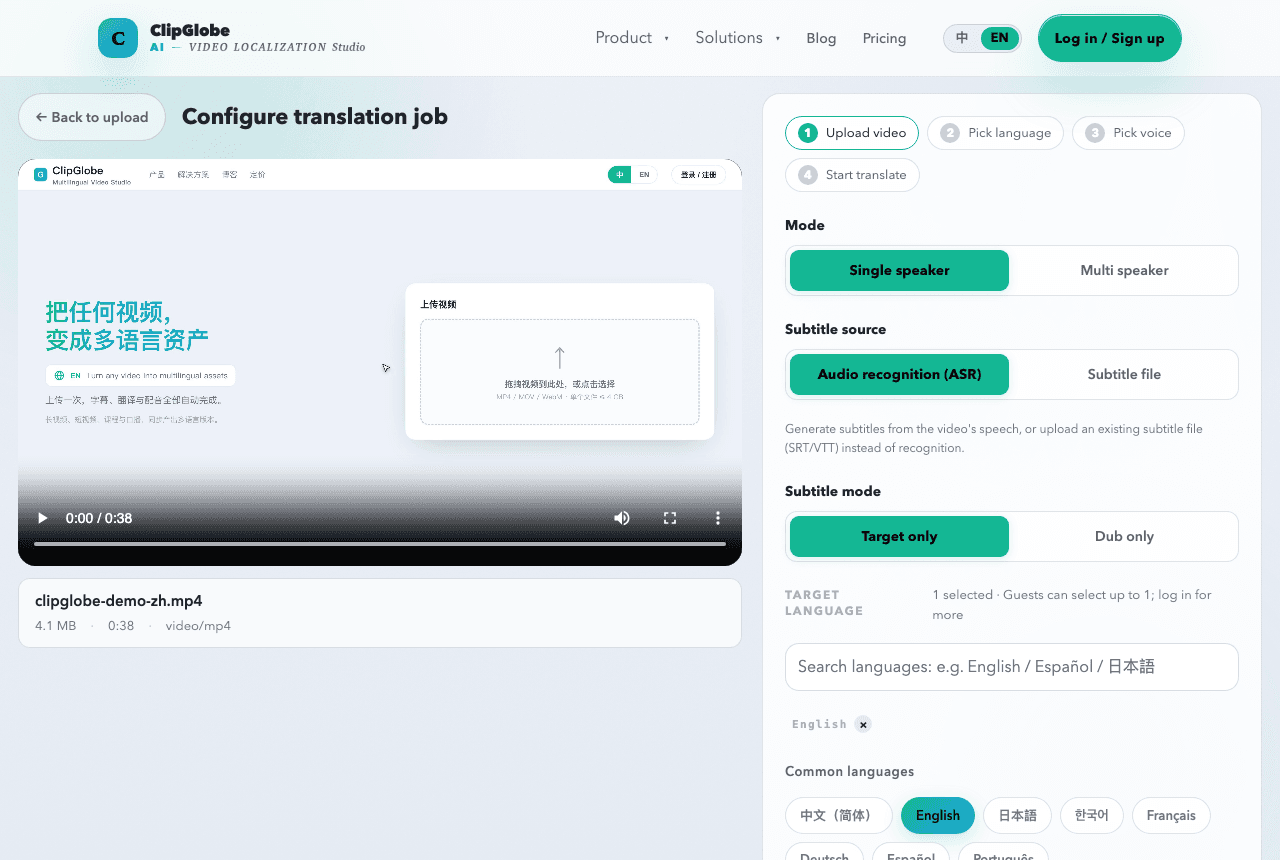
- Pick 5 representative videos (one tutorial, one demo, one ad) and run the full flow before rolling out.
- The pilot only needs to answer three things: is terminology stable, is the voice acceptable, how long does human review take.
- Use pilot data to estimate real per-language cost and turnaround, then decide how many languages and who reviews.